






.png?locale=en)






Alsharq Tribune-M.Essam
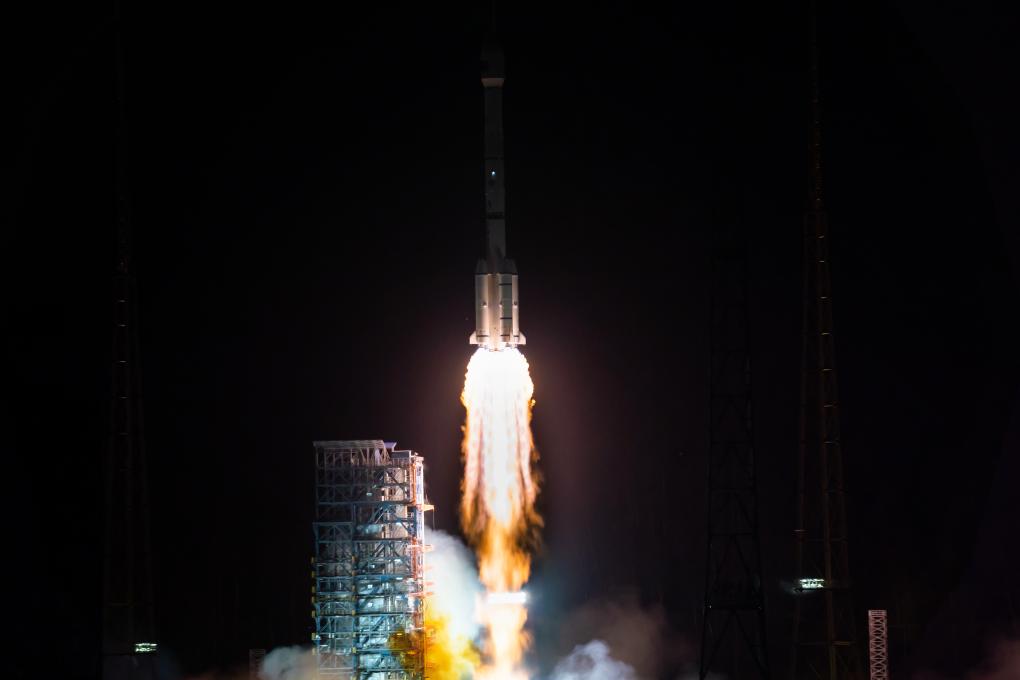
Iran on Sunday successfully launched three domestically produced satellites into space for agriculture and environmental research from a Russian launch site, marking the seventh time the country has used Russian rockets for satellite deployment, the official news agency IRNA reported.
The remote sensing satellites -- Zafar-2, Paya and Kowsar-1.5 -- were launched into a low-Earth orbit 500 km above the Earth by a Soyuz-2.1b rocket from the Vostochny Cosmodrome in eastern Russia, according to IRNA. The Russian rocket, lifting off at 16:48 Tehran time (1318 GMT), also carried 49 other satellites, including a pair of Aist-2T, Russian optical Earth observation satellites.
Iran's Space Agency chief Hassan Salarieh said the launch "reflects the expanding scope of Iran's space program and the rapid growth of new players in this field."
Made by Iran Electronics Industries, Paya is considered one of Iran's most advanced domestically built imaging satellite to date and the country's heaviest homegrown satellite, IRNA said. Weighing about 150 kg, it uses artificial intelligence to enhance image resolution and is expected to support water resource management, environmental monitoring, and geographic mapping.
Zafar-2 satellite, designed and built at Iran University of Science and Technology, is made of aluminum, weighing between 100 and 135 kg, the report added, noting it aims to transmit high-resolution images for monitoring natural resources and environment, agriculture and crisis management.
Kowsar-1.5, produced by Iran's Space Omid company, is capable of capturing images with a resolution of about 4 meters, enabling space imaging and collection of data from Earth sensors simultaneously, IRNA said, adding it can be used for precision agriculture as well as water resources, environment and territorial monitoring.
Speaking at a ceremony in the Iranian capital Tehran to celebrate the launch, Iran's Minister of Information and Communications Technology Seyed Sattar Hashemi said developing space industry was a "strategic necessity" for the country.
In an address to reporters on Friday, Iranian Foreign Minister Seyed Abbas Araghchi stressed Iran's satellite program was strictly civilian for scientific and peaceful use, and like other countries, Tehran had a legitimate right to pursue satellite programs for non-military purposes, the semi-official Mehr news agency reported.